
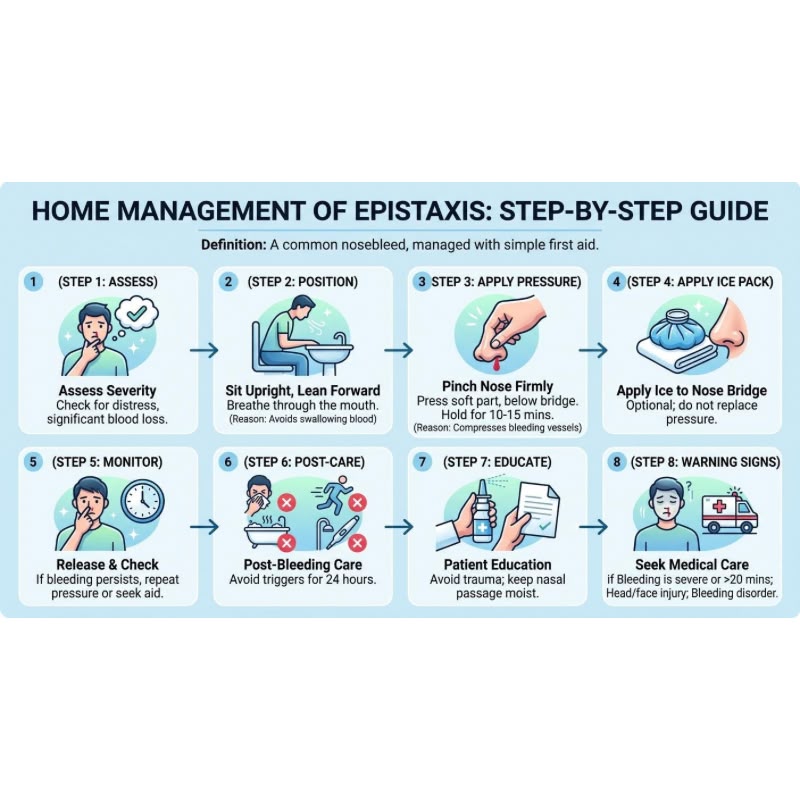
*Definition:*
Epistaxis, commonly known as a nosebleed, is the bleeding of blood vessels within the nasal cavity. It may occur due to dry air, nose picking, trauma, irritation of the nasal lining, or other underlying medical conditions. Most mild nosebleeds can be managed at home with appropriate first aid.
*STEP-BY-STEP PROCEDURE*
*Step 1: Assess the Patient*
Assess the patient’s general condition and determine the severity of the bleeding. Check for dizziness, weakness, difficulty breathing, or significant blood loss. If the bleeding is severe or the patient appears unwell, seek emergency medical assistance immediately.
*Step 2: Position the Patient*
Ask the patient to sit upright in a chair and lean slightly forward. Encourage the patient to breathe through the mouth.
*Reason:* This position prevents blood from flowing down the throat, reducing the risk of choking, nausea, and vomiting.
*Step 3: Apply Direct Pressure*
Using the thumb and index finger, firmly pinch the soft, fleshy part of the nose just below the bony bridge. Ensure that both nostrils are compressed.
Maintain continuous pressure for 10–15 minutes without releasing the nose to check whether the bleeding has stopped.
*Reason:* Direct pressure compresses the bleeding blood vessels and promotes clot formation.
*Step 4: Apply an Ice Pack*
Wrap an ice pack or a bag of ice in a clean, thin towel. Gently place it over the bridge of the nose while maintaining pressure on the soft part of the nose.
Do not apply ice directly to the skin. The ice pack is an optional supportive measure and must not replace direct pressure.
*Reason:* Cold may cause vasoconstriction (narrowing of blood vessels). However, evidence that an ice pack effectively stops nosebleeds is limited.
*Step 5: Monitor the Bleeding*
After maintaining pressure continuously for 10–15 minutes, carefully release the nose and check whether the bleeding has stopped.
If bleeding continues, maintain appropriate first aid while arranging urgent medical assessment. Do not delay seeking help if the bleeding is heavy or the patient develops dizziness, weakness, or difficulty breathing.
*Step 6: Provide Post-Bleeding Care*
Once the bleeding has stopped, advise the patient to:
Avoid blowing or picking the nose for at least 24 hours.
Avoid strenuous physical activities and heavy lifting.
Avoid hot drinks and very hot baths immediately after the episode.
Avoid inserting tissue or other objects into the nostrils.
Keep the nasal passages moist with a saline nasal spray if needed.
*Step 7: Educate the Patient*
Explain the importance of avoiding nose picking, preventing nasal dryness, and avoiding unnecessary trauma to the nose. Advise the patient to seek medical assessment if nosebleeds occur repeatedly.
*Step 8: Identify Warning Signs*
Instruct the patient to seek emergency medical care if:
The bleeding is heavy.
The bleeding persists for approximately 20 minutes despite correct, continuous pressure.
The patient experiences dizziness, fainting, marked weakness, or difficulty breathing.
The nosebleed follows a serious head or facial injury.
The patient has a known bleeding disorder or takes blood-thinning medication and the bleeding is difficult to control.
*CONCLUSION*
Epistaxis can often be managed at home when the bleeding is mild. The recommended first-aid measures include sitting upright, leaning forward, applying continuous pressure to the soft part of the nose, and using an ice pack as an optional supportive measure. Severe, persistent, or recurrent nosebleeds require appropriate medical assessment.
*Clinical Note:* Direct pressure is the primary first-aid intervention for epistaxis. An ice pack is optional because evidence supporting its effectiveness is limited.